The Biggest Reason Homeowners Hesitate
We get calls from homeowners who have been thinking about cabinet refinishing for over a year. Not because they are unsure they want it. They know they want it. They hesitate because they do not know what having a contractor work in their home for several days actually looks like.
How much dust? How loud? Do they need to empty every cabinet? Will the kitchen smell for a week? Can the family still eat dinner at home?
Those are fair questions, and the fact that most refinishing companies do not answer them upfront is a real problem. So here is the full picture. This is exactly how cabinet refinishing works step by step at Suncoast Refinishing, from the first call to the final walkthrough.
Step One: The Estimate and Planning Conversation
We start with a free, no-pressure estimate. One of our team members comes to your home, looks at the cabinets, and has an honest conversation about what is possible.
Not every cabinet is a good candidate for refinishing. If the boxes are structurally compromised, if there is water damage behind the surface, or if the existing finish has deep substrate issues, we will tell you that. We would rather recommend the right service than take a job that will not hold up.
During this visit we also discuss color, sheen level, and whether the project makes more sense as a refinish of existing doors or a full refacing with new door fronts. Those are different services with different outcomes, and the right answer depends on the condition and style of your current doors. See how those two options compare on our cabinet refacing page.
Most estimates take 30 to 45 minutes. You get a written quote before we leave.
Step Two: Prep Work, and Why It Determines Everything
This is the step that separates a professional result from a DIY disaster.
Before any coating goes near your cabinets, we do thorough surface preparation. That means:
All hardware is removed. Hinges, knobs, pulls, everything comes off. We label and bag hardware so reinstallation is clean.
Doors and drawer fronts are removed from the boxes and transported to our shop for finishing in a controlled environment. This is important. Spraying doors on-site with the kitchen in use introduces contamination. Our shop environment is clean and temperature-controlled.
The cabinet boxes that stay in the kitchen are cleaned, degreased, and scuff-sanded. Kitchen grease is invisible to the naked eye but it is everywhere on cabinet surfaces, and it will prevent adhesion if it is not removed completely. We use professional-grade degreasers, not the household stuff.
According to the American Coatings Association’s finishing guidelines, proper surface preparation accounts for the majority of a coating’s long-term performance. We have always believed that. A great finish on poor prep fails. Great prep with a great finish lasts.
Step Three: The Coating System We Use and Why It Matters
Not all cabinet paint is equal. This deserves a direct explanation because homeowners are sometimes surprised by how different professional coatings are from what is available at a hardware store.
We use a factory-grade 2k water-based system called Novalk. The “2k” refers to a two-component product: a base and a hardener that are mixed just before application. Once catalyzed, the coating cures to a hardness and chemical resistance that single-component paints cannot match.
The result is a finish that is:
- Resistant to moisture and humidity, which matters a lot in Florida
- Hard enough to withstand daily contact, cleaning, and the occasional impact
- Non-yellowing over time, which standard oil-based finishes are not
We spray this system in multiple controlled coats with proper flash time between each. The final product looks and performs like a factory finish because it essentially is one.
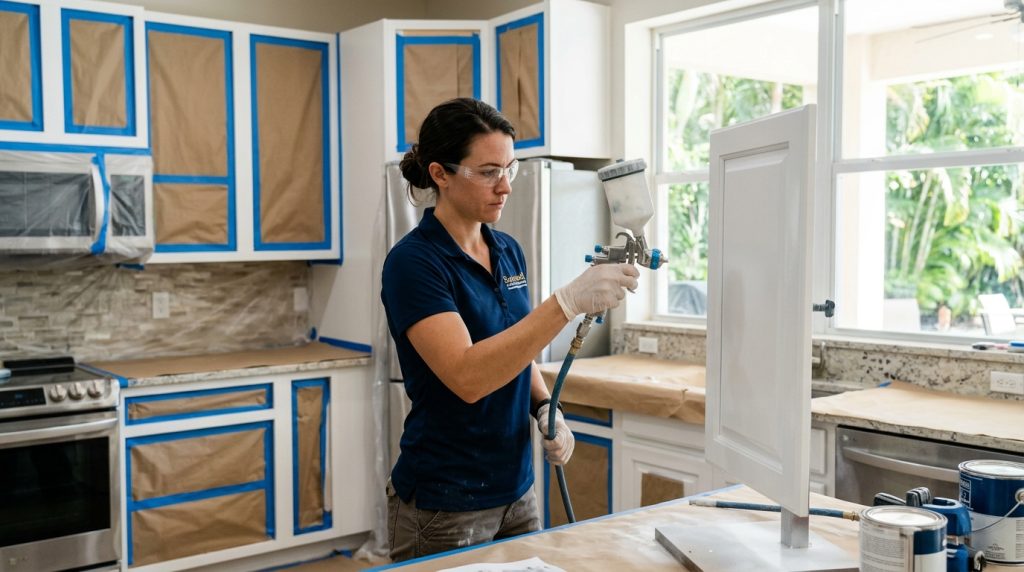
The doors come back from our shop and the boxes are finished in place. The entire application process in your home is done with our dust-free system, so the mess you might expect from a major project simply does not materialize the way most homeowners fear.
Step Four: What Happens in Your Home During the Project
This is the part people want to know most.
For a typical kitchen, the in-home portion of the project runs two to three days. On day one, we remove the doors and hardware, prep the cabinet boxes, and begin coating the boxes in place. Doors go to the shop.
The kitchen is not fully functional during this time. But you are not locked out of it either. You can access the pantry, the refrigerator, and the sink. We work cleanly and protect your floors and appliances. The cooking situation is more inconvenient than impossible, and most families manage fine with simple meals during the project days.
Our dust-free process means we are not generating clouds of sanding debris throughout the house. The containment is genuine, not just a marketing claim. We use professional-grade vacuums and shop equipment that capture particulate at the source.
By day two or three, doors come back from the shop fully finished. We hang them, adjust for alignment, install the soft-close hardware that comes included with every full refinish, and do a careful walkthrough with the homeowner.
You can learn more about the full scope of what is included in a project on our cabinet refinishing page.
Step Five: Curing, Care, and the Warranty
Here is a detail a lot of homeowners do not anticipate. The coating is dry to the touch quickly, but it is not fully cured for several days after application.
During the first 30 days, we recommend gentle treatment. No harsh cleaning chemicals, no abrasive scrubbing, avoid leaving standing water against the surfaces. After 30 days, the finish has fully cross-linked and you can clean it normally with a mild soap and soft cloth.
Long-term, the 2k system is genuinely durable. We back our work with a 5-year service warranty. If there is an adhesion issue, a peeling edge, or any defect related to our application, we come back and address it. That warranty matters to us because our reputation is built on work that holds up in real Florida kitchens, not just on the day the project finishes.
For context on how professional coatings perform over time, this overview from the Painting and Decorating Contractors of America covers how proper coating systems applied by trained professionals consistently outperform DIY or consumer-grade products in adhesion and longevity.
What Cabinet Refinishing Is Not
Briefly, because it is worth saying clearly: cabinet refinishing is not painting your cabinets with a roller and a can of Benjamin Moore.
That approach, which some homeowners attempt themselves or hire cheap contractors to do, produces a finish that looks fine for six months and then starts failing. Brush marks, peeling edges, chips at door corners. We have refinished over other people’s work more times than I can count, and the failures are almost always traceable to poor prep, wrong product, or wrong application method.
Professional refinishing done correctly is a different category of outcome. It costs more than a DIY attempt for real reasons.
Ready to See the Process in Person
The best way to understand what cabinet refinishing looks like in your specific kitchen is to have someone come look at it. We offer free estimates with no obligation, and we are happy to walk through the process in person, answer every question, and give you a clear number before any decision is made.
Call us or fill out our contact form and we will set up a time that works for your schedule. We serve Sarasota, Lakewood Ranch, Venice, and Bradenton, and we are typically able to schedule estimates within a few days.